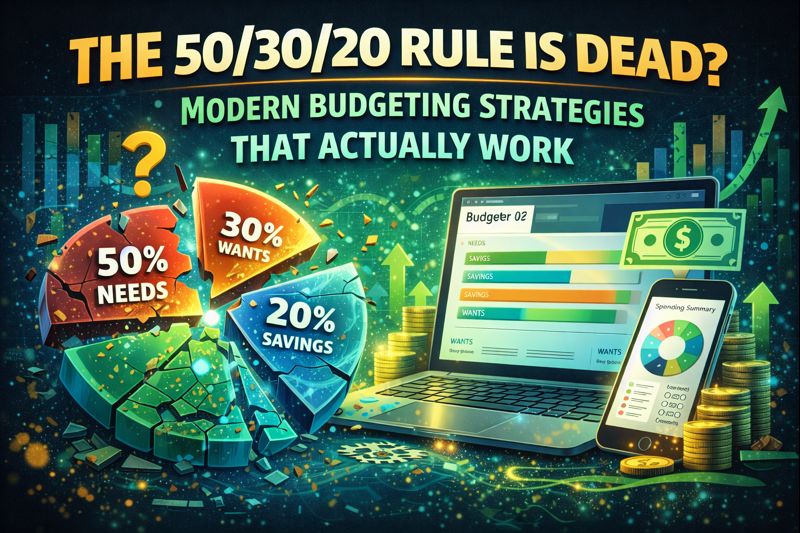
The 50/30/20 Rule is Dead? Modern Budgeting Strategies That Actually Work
The classic 50/30/20 rule (50% needs, 30% wants, 20% savings/debt) has been a personal finance staple for years. But in an era of soaring housing costs, gig economy income, and financial complexity, does this one-size-fits-all approach still hold up?
For many, the rigid percentages no longer reflect reality—especially when “needs” often consume 60-70% of take-home pay. But its core wisdom—intentional spending, balancing essentials with goals—is more relevant than ever. The evolution isn’t about discarding budgeting, but adapting it to modern financial lives.
Why the Traditional Rule Feels Outdated
-
Skyrocketing Fixed Costs: Housing, healthcare, insurance, and education often exceed 50% alone for millennials and Gen Z.
-
Variable & Gig Income: The rule assumes stable monthly income, not the reality of freelancers or commission-based workers.
-
Debt Realities: Many carry student loan or credit card payments that don’t neatly fit into 20%.
-
Regional Cost Disparities: A salary in San Francisco versus St. Louis creates vastly different “need” percentages.
Modern Budgeting Strategies That Actually Work
1. The “Values-Based” Budget (The Priority-First Method)
For: Those who want their money to reflect their life priorities, not just categories.
How it works:
-
Identify your top 3-5 financial values (e.g., travel, early retirement, family security, education, philanthropy).
-
Pay yourself first toward these goals (automate transfers).
-
Cover your essential bills.
-
Use what’s left for discretionary spending—guilt-free.
The shift: It moves from restriction (“I can’t spend on this”) to intention (“I’m choosing to fund what matters most”).
2. The “Reverse Budget” (Pay-Yourself-First Aggressively)
For: Natural savers or those focused on big goals like FIRE (Financial Independence, Retire Early).
How it works:
-
Set your savings/investment goal first (e.g., 30%, 40%, or 50% of income).
-
Automate that amount into savings/investments immediately upon payday.
-
Live on the remaining money for all expenses—needs and wants combined.
The shift: Savings is no longer a leftover—it’s the primary monthly “bill” you pay to your future self.
3. The “Cash-Flow” or “Zero-Based” Budget (Every Dollar Has a Job)
For: Those who want maximum control and detail, especially useful with variable income.
How it works:
-
List your monthly income.
-
Assign every single dollar a purpose until your income minus your allocations equals zero. Categories can be as specific as “Groceries,” “Fuel,” “Netflix,” “Christmas Fund.”
-
Track diligently (apps like YNAB excel here).
The shift: It creates proactive awareness, eliminating “mystery spending” and making you the CEO of your cash flow.
4. The “Modular” or “Bucket” Budget
For: Visual learners, families, or those managing multiple goals.
How it works:
-
Create separate accounts or virtual “buckets” (many digital banks offer this feature).
-
Name each bucket for a goal or category (e.g., “Rent,” “Vacation,” “Emergency Fund,” “Dog Vet Fund”).
-
Fund each bucket on payday according to your plan.
The shift: Money is physically or visually segregated, preventing goal-funds from being accidentally spent.
5. The “80/20” Simplified Rule (A 50/30/20 Adaptation)
For: Those who want a framework but need simplicity.
How it works:
-
20% goes to savings & debt repayment (the non-negotiable).
-
80% is for everything else—all your living and lifestyle expenses, combined.
The shift: It reduces category stress while preserving the crucial savings habit.
How to Choose Your Strategy
Ask yourself:
-
“Am I a detailed tracker or a big-picture thinker?” (Zero-Based vs. Reverse)
-
“Do I have stable or variable income?” (Cash-Flow works well for variable)
-
“What’s my biggest challenge: overspending or undersaving?” (Values-Based tackles overspending; Reverse tackles undersaving)
-
“Do I need to see my money to understand it?” (Choose Bucket Budgeting)
The Unkillable Core Principle
Whether the 50/30/20 rule is “dead” is less important than this truth: a budget is simply a plan for your money. A plan reduces anxiety, empowers choice, and turns money from a source of stress into a tool for building the life you want.
The modern takeaway is flexibility. Your budget should be a living document that adapts to your life stage, income shocks, and changing goals—not a rigid percentage that causes guilt.
Start Here: Review last month’s bank statement. Where did your money actually go? That awareness is the first and most powerful step toward any effective budget—modern or classic.
Leave a Reply